Monday, December 25, 2006
Don't be a Graphic Designer
Be a graphic broadway producer. Be a graphic lawyer. The role of the graphic designer is to not simply execute the visual vision of the client. The graphic designer's role is to solve business problems with visual solutions. And, to do that, the mindset of the graphic designer must change from artist to artist / [insert title of professional for project at hand].

Monday, August 21, 2006
Nolita - Soho Advertisement
In any other neighborhood besides Soho, this would look destitute, but because it's Soho, it's artistic, and it succeeded. It caught people's attention. The end-game: show the grass on the other side. If you're poor, be rich. If you're rich, appear poor.
Sunday, August 20, 2006
Foreign Affairs Ad Concepts

I recently saw photos taken in areas around the world with active disputes, and thought of this ad campaign. I think this campaign is needed for FA for two reasons:
1) It's people centric. In contrast to current FA promotions, this shows people, and 'people' are at the root of why we read and care about international relations. Ads that just show text and images without people do NOT relate as well to readers.
2) Competitors are using ad campaigns with people in them, and they are benefiting from using this imagery. In particular, the Economist is full of images.
Where this campaign can run:
1) In other magazines
2) In banner ads on other websites
3) In inserts put into other magazines
4) In mailings to non-subscribers (i.e. direct mail)
Sunday, December 11, 2005
Lenox Ad

I like how Lenox combines so many nice elements here: 1) the card is hand-written, making the ad approachable, inviting; 2) there are products listed on the left-hand side, making it practical; and 3) there is a nice photo of people that draws you into a happy, romantic, personal story.
Mini Ad(s)

I love how Mini Cooper played off the littel boxy ads of this yuppie magazine to promote its car's small size and fun spirit.
Wednesday, October 12, 2005
Environmetally Friendly Envelope
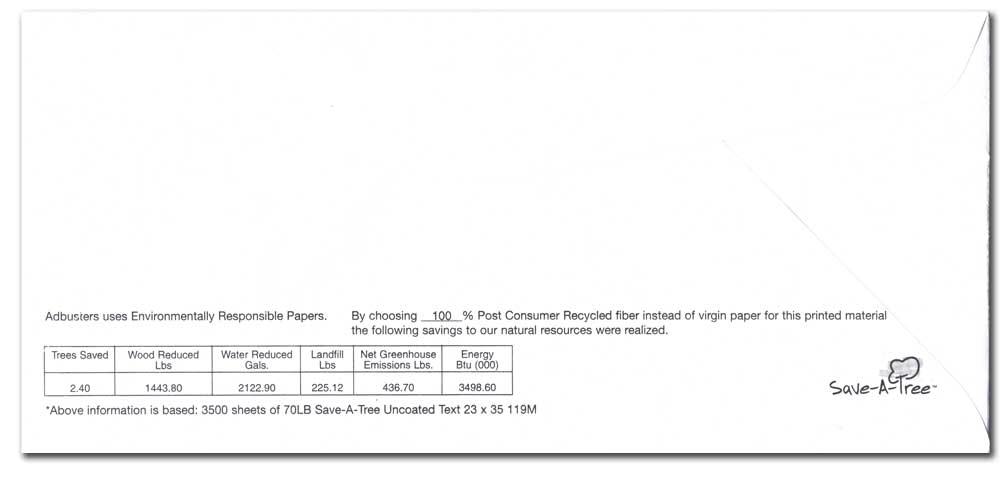
Great idea: show your consumers you care about saving money and the environment. I would recommend this for Foreign Affairs (after all, isn't IR really about managing oil?), Budget Travel (how can you promote rainforest travel AND not saving trees?), and just about every publication....except for "Oil Weekly."
Saturday, August 06, 2005
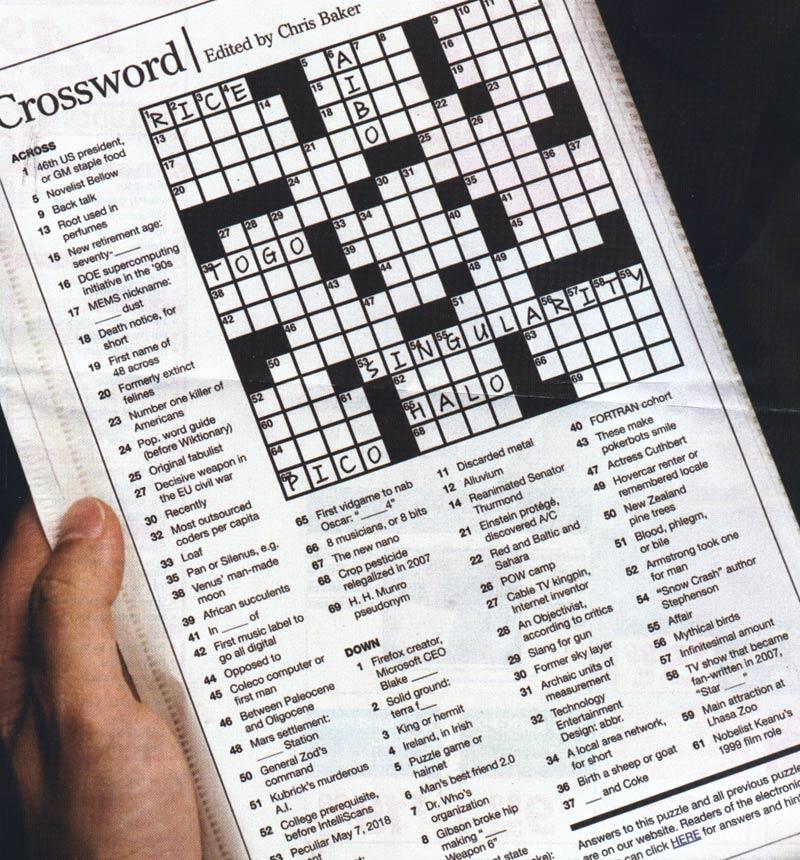
New York Times Crossword Puzzle, August 16, 2019
ingenious piece. i love what this graphic concoction says about our society.
i also think it's indicative of how Wired helps us see international relations and the world in a fun way.

i also think it's indicative of how Wired helps us see international relations and the world in a fun way.
Thursday, July 07, 2005

Monday, July 04, 2005
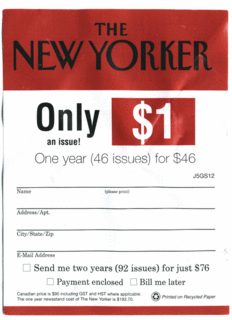
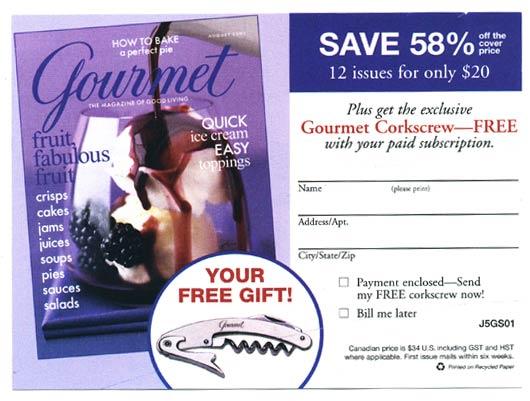
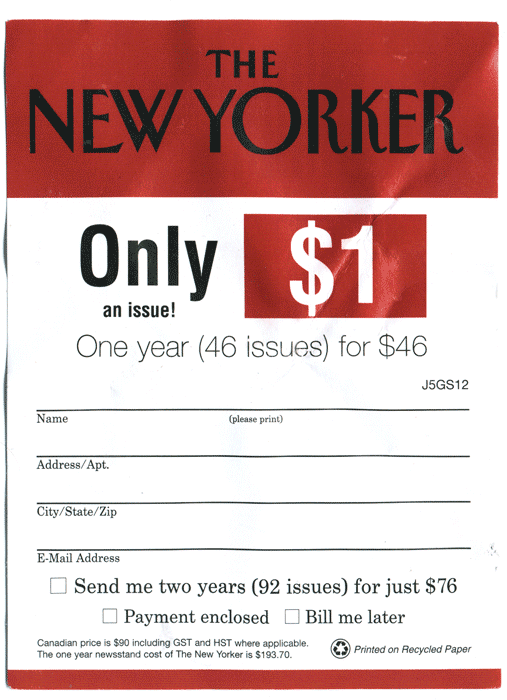
Nice Magazine Pomo Cards
I like how the New Yorker simply appeals to your inner bargain hunter: each issue is just $1. And Cargo wants to give you a bag that is "obviously" more than what you pay for the subscription....And Gourmet is offering that elegant, expensive corkscrew....so how can you lose?



Wednesday, March 16, 2005
Coffee and Cigarettes: Same Owner
Strange to think that Maxwell House is owned by Kraft, which is owned by Altria. Altria? Altria is formerly known as Phillip Morris, the tobacco company that helps 1,200 people die a day in the US from cigarette related deaths. Phillip Morris changed its name to Altria to try and confuse people that is was no longer Phillip Morris.

Will New Machines
Perk Up Coffee Sales?
By SARAH ELLISON
Staff Reporter of THE WALL STREET JOURNAL
March 16, 2005; Page B1
Roger Deromedi, Kraft Foods Inc.'s chief executive, works most days next to a row of coffee machines on a table in his office. He likes to test Kraft's newest creation, a coffee "system" called Tassimo, against products from rivals such as Nestlé SA and Procter & Gamble Co. It's become such a pet project for the CEO that Kraft insiders affectionately call him Tassimo's "brand manager."
Mr. Deromedi has good reason for his obsession: Tassimo represents Kraft's answer to a pressing problems confronting one of the world's big coffee sellers -- how to win back American coffee drinkers. Kraft sells more coffee than any other company in the world, and for years, Kraft's Maxwell House brand, along with rival Folgers from P&G, defined America's coffee preferences. But sales of those products, like those of many other iconic packaged foods, are being pinched from below, by low-priced private-label brands, and from above by expensive specialty products sold at chains like Starbucks Corp.
Kraft's Mr. Deromedi figures the way to bring consumers back is to move upscale and sell coffee the same way Gillette sells razor blades and P&G sells Swiffer mops, by hooking consumers on premium-priced refills. The Tassimo machine makes coffee, tea and hot chocolate using only Kraft refills, which it calls "T-discs." So for Kraft, selling the machine means months, if not years, of T-disc sales to come.
Drinking a cup of Tassimo "Voluptuoso" coffee, his favorite variety, Mr. Deromedi muses about the product's potential. "I think we can revolutionize the way people think of drinking coffee at home," he says. The Tassimo machine is perhaps Kraft's most radical innovation since Mr. Deromedi became sole CEO in December 2003. And it's part of a broader vision he has for Kraft, in which proprietary technologies could one day be harnessed to sell products as varied as packaged soups, cold remedies and other drinks. Kraft has about 20 patents protecting the Tassimo product.
Will New Machines
Perk Up Coffee Sales?
By SARAH ELLISON
Staff Reporter of THE WALL STREET JOURNAL
March 16, 2005; Page B1
Roger Deromedi, Kraft Foods Inc.'s chief executive, works most days next to a row of coffee machines on a table in his office. He likes to test Kraft's newest creation, a coffee "system" called Tassimo, against products from rivals such as Nestlé SA and Procter & Gamble Co. It's become such a pet project for the CEO that Kraft insiders affectionately call him Tassimo's "brand manager."
Mr. Deromedi has good reason for his obsession: Tassimo represents Kraft's answer to a pressing problems confronting one of the world's big coffee sellers -- how to win back American coffee drinkers. Kraft sells more coffee than any other company in the world, and for years, Kraft's Maxwell House brand, along with rival Folgers from P&G, defined America's coffee preferences. But sales of those products, like those of many other iconic packaged foods, are being pinched from below, by low-priced private-label brands, and from above by expensive specialty products sold at chains like Starbucks Corp.
Kraft's Mr. Deromedi figures the way to bring consumers back is to move upscale and sell coffee the same way Gillette sells razor blades and P&G sells Swiffer mops, by hooking consumers on premium-priced refills. The Tassimo machine makes coffee, tea and hot chocolate using only Kraft refills, which it calls "T-discs." So for Kraft, selling the machine means months, if not years, of T-disc sales to come.
Drinking a cup of Tassimo "Voluptuoso" coffee, his favorite variety, Mr. Deromedi muses about the product's potential. "I think we can revolutionize the way people think of drinking coffee at home," he says. The Tassimo machine is perhaps Kraft's most radical innovation since Mr. Deromedi became sole CEO in December 2003. And it's part of a broader vision he has for Kraft, in which proprietary technologies could one day be harnessed to sell products as varied as packaged soups, cold remedies and other drinks. Kraft has about 20 patents protecting the Tassimo product.
Monday, March 14, 2005
Would LIke to See Foreign Affairs Add This...

Foreign Affairs is great...yet, there is so much information...and no pictures...so, how about a compromise? Just let us know where to look for what we're interested in....
For example, offer a side bar like Budget Travel that tells what page a country is mentioned.
Nice Promo from Budget Travel

Smart how each subscription card is different, and they work synergistically to make up a larger impression.
Thursday, March 10, 2005
News
i can't encourage us to read both papers enough...
it's strange...the Sun is accusing the saudis and columbia univ. of collusion--in bold letters on the front page, and the times is reporting on israels illegal settlements...
how can one who doesn't read both papers know the story?
it's strange...the Sun is accusing the saudis and columbia univ. of collusion--in bold letters on the front page, and the times is reporting on israels illegal settlements...
how can one who doesn't read both papers know the story?
Monday, February 28, 2005
Nice idea by Norman Foster for NYC

NYT
2/28/2005
If all the world's a stage, why not Castle Williams, that crumbling bulwark on Governors Island, with its stone fortifications, circular courtyard and haunting past as a military prison? The British architect Norman Foster has designed an adaptation of Shakespeare's Globe Theater in London that would fit inside the 194-year-old castle and serve as a stage for Shakespeare productions and other performing arts.
The theater is one of several proposals being considered for the site by the National Park Service, which owns and operates 22 acres of the 172-acre island, a former military installation in New York Harbor that includes Castle Williams and Fort Jay.
The Park Service is currently soliciting online public input and suggestions for the site's future, said Linda Neal, the superintendent of the Governors Island National Monument for the Park Service, who described the Globe proposal as exciting.
Christo and Mercedes
Good product placemant by Mercedes for Christo and the Gates...
from NYT, Feb 28, 2005
****
After a brief stroll on the edge of the Sheep Meadow, Jeanne-Claude returned to the car, a Mercedes Maybach on loan for a few weeks from DaimlerChrysler. She said she originally laughed at the idea of the Maybach - "We don't even own a bicycle" - but she clearly cannot get enough of the car.
Out of a side-door compartment, she fished a saffron-colored Band-Aid tin, and from the tin snatched a cigarette. An assistant came to the window with a report: Someone had cut hearts out of the fabric in four gates. It's always something; a few minutes earlier she pointed out a brand new gate, a replacement for the one that was hit by a taxicab. Was there much vandalism?
"Vandalism?" she repeated. "Cutting out hearts? It annoys us, but I can't call that vandalism."
Suddenly the door opened, and Christo tumbled into the back seat. Before the door closed, he was debating whether they had time to eat lunch, since it was the last day Mr. Volz could take pictures and had much more to do.
"We always eat in 12 minutes," Jeanne-Claude said.
"To the boathouse, quick, quick," Christo said to the driver.
****
from NYT, Feb 28, 2005
****
After a brief stroll on the edge of the Sheep Meadow, Jeanne-Claude returned to the car, a Mercedes Maybach on loan for a few weeks from DaimlerChrysler. She said she originally laughed at the idea of the Maybach - "We don't even own a bicycle" - but she clearly cannot get enough of the car.
Out of a side-door compartment, she fished a saffron-colored Band-Aid tin, and from the tin snatched a cigarette. An assistant came to the window with a report: Someone had cut hearts out of the fabric in four gates. It's always something; a few minutes earlier she pointed out a brand new gate, a replacement for the one that was hit by a taxicab. Was there much vandalism?
"Vandalism?" she repeated. "Cutting out hearts? It annoys us, but I can't call that vandalism."
Suddenly the door opened, and Christo tumbled into the back seat. Before the door closed, he was debating whether they had time to eat lunch, since it was the last day Mr. Volz could take pictures and had much more to do.
"We always eat in 12 minutes," Jeanne-Claude said.
"To the boathouse, quick, quick," Christo said to the driver.
****
Furniture ad using magazines
Any magazine with its content could be used to take advantage of this presentation technique...Smart.

Old and new ad design
Mixing the importance of history with present day life, in all it's pleasantries, can be a challenge...History Channel does this well here by melding two images from the same place, different time.

modernist approach to modernism
i think this article in Metropolis summarize pretty well what happens to modern architecture by SOM and the likes:
Checkpoint Checkup
By Max Page
Twenty-five years ago West Berlin invited the world’s most celebrated architects to help rebuild devastated parts of the divided city. What is the legacy of that ambitious effort?
the article concludes that the buildings look boring, and the buildings style was a missed opportunity to spend the money with better design in mind.
Checkpoint Checkup
By Max Page
Twenty-five years ago West Berlin invited the world’s most celebrated architects to help rebuild devastated parts of the divided city. What is the legacy of that ambitious effort?
the article concludes that the buildings look boring, and the buildings style was a missed opportunity to spend the money with better design in mind.

Graphic layout promoting depth
This concept would work well for a magazine, placing the magazine in the foreground, and an image of the area's expertise in the background.


Sunday, February 27, 2005
Nice passport ad idea
This theme may be good for Foreign Affairs....structure magazine promo piece as passport.


Thursday, January 20, 2005
Dressing like Beyonce not good enough? Live like her too...
i love to see old-fashioned, suburban JC Penny score a deal with hip, urban MTV. Kudos to them.
JC Penny is selling MTV Cribs home furnishings:
http://www.jcpenny.com/mtv
I always thought people would love to buy furniture and floorplans seen in movies, like Batman and Lord of the Rings.
JC Penny is selling MTV Cribs home furnishings:
http://www.jcpenny.com/mtv
I always thought people would love to buy furniture and floorplans seen in movies, like Batman and Lord of the Rings.
Tuesday, January 18, 2005
Can you hear it?
never thought you'd get a tatoo?
think again...
http://h10049.www1.hp.com/music/us/en/index_flash.jsp
HP's new promotion, that costs just pennies.
think again...
http://h10049.www1.hp.com/music/us/en/index_flash.jsp
HP's new promotion, that costs just pennies.
Friday, January 14, 2005
Ring Google.com
And, for those that don't want for YellowArrow to prompt you, just ask for anything:
http://www.google.com/sms/howtouse.html
http://www.google.com/sms/howtouse.html
Follow the Yellow Arrow to the Wizard
i find this to be pretty creative...
and, almost functional:
https://www.yellowarrow.org/intro.php
what can be done with this?
can it catch your eye to tell you something about the High Line?
tell you about Open House New York?
about a pile of snow, then it tells you the temperature in the Bahamas, with the BudgetTravel web site, so you want to pick up BudgetTravel and book a trip to the Bahamas?
about a store that rips you off?
about Trumps bad architecture?
What if there was a huge one of the side on an airplane?
A car?
A building?
and, almost functional:
https://www.yellowarrow.org/intro.php
what can be done with this?
can it catch your eye to tell you something about the High Line?
tell you about Open House New York?
about a pile of snow, then it tells you the temperature in the Bahamas, with the BudgetTravel web site, so you want to pick up BudgetTravel and book a trip to the Bahamas?
about a store that rips you off?
about Trumps bad architecture?
What if there was a huge one of the side on an airplane?
A car?
A building?
Wednesday, January 12, 2005
What Can This Pen Do For You and Your Field?

New Computer Pen Reads Handwriting And Can Talk Back
By STEPHANIE KANG
Staff Reporter of THE WALL STREET JOURNAL
January 12, 2005; Page B1
In a consumer electronics market flooded with iPods and Xboxes, LeapFrog Enterprises Inc. is making a play for 8-to-13-year-olds with a talking digital pen that answers math problems, corrects spelling and plays fantasy baseball games.
The product, called FLY, is a "pentop computer" from LeapFrog and Swedish technology firm Anoto AB. The $99 gadget is essentially a pen with computer electronics that captures text in a digital file as the user writes on special paper covered with barely visible gray dots. As bulky as a thick magic marker, FLY uses a small camera hidden under the tip that records writing at about 75 frames per second. The pen's software can "read" a user's handwriting or drawing and then orally respond.
For example, a student can draw a "calculator" pad on the paper, touch the pen to the numbers of an equation and hear the answer through the pen's speaker. Writing out an equation, say, "2+2," generates the same result. The pen will answer "4." It can give hints on how to do long division, spell words or quiz students with interactive worksheets. Handwritten English words can be translated through the pen's speakers into Spanish or French.
The pen can also be used musically: a rectangle drawn into eight slices becomes a keyboard's eight notes so the writer hears different notes when touching each slice. Similarly, a set of drawn circles turn into a drum kit, with different percussion sounds generated by touching the circles with the pen. Users can compose music using different beats and sounds, which can then be downloaded as a cellphone ringtone.
The $99 FLY computer pen.
Basic computer functions such as an alarm clock and calendar are available. The calendar would note that soccer practice starts at 4 p.m. on Mondays. At that date, the pen reminds the user of the practice.
LeapFrog plans to begin selling the pen in the fall, and it's already thinking about some possible complications. If a user writes an obscenity, for example, the pen may respond with an oral message like, "You can't say that." And while illegible handwriting is another possible problem, LeapFrog thinks that by age 8, most kids' penmanship will be good enough to be recognized by the computer.
Since the pen isn't yet on the market, some unexpected glitches could crop up. The pen holds a lexicon of about 70,000 words, but if a user writes a word that isn't covered by the program, the pen will say it doesn't recognize the entry and advise the user to try again. FLY has limitations: its calculator cannot do fractions, for instance.
While LeapFrog and others have made technology-driven products for young children, there is very little available for kids as they head into their teens. Jim Marggraff, an executive vice president at LeapFrog and developer of FLY, believes the pen's ability to deliver high-tech computer capability in the low-tech format of pen and paper is not only learning-friendly, but also the start of a "new medium of technology."
Leapfrog has tried to give the pen features that will make it cool for tweens. Products for girls include an interactive diary that asks users questions to stimulate journaling. Boys can play an interactive fantasy baseball game that uses Upper Deck baseball cards and comes with sound effects like the crack of a bat and an announcer's voice.
Mr. Marggraff began thinking about FLY in 2000, when he saw a story about Anoto in Wired magazine. At that time, Anoto's technology was being used as a business-to-business tool in the legal and health-care industries. Anoto developed a special pen that, when used with the dot paper, would download writing into a computer. When used in a doctor's office, for example, a form filled out with the special pen and paper would be stored in the office's computer system.
Adding LeapPad's audio technology would create a new type of computer product, Mr. Marggraff thought -- one that could do "everything a Leap can do without the LeapPad," he says.
Although versions of pen computers have been around for about a decade, analysts say FLY is the first such device aimed at kids for educational purposes and therefore might be a hard sell to teachers and parents. "Overall the educational market is slow to adapt technology," says Tim Bajarin, president of technology research firm Creative Strategies Inc. who has used FLY. "Parents sometimes have an aversion to using technology even for educational things, especially parents from an older generation."
The toughest group to convince may be the target audience themselves. Although still popular with the 3-to-8-year-old set, LeapFrog products for older students haven't fared as well, says Harris Nesbitt analyst Sean McGowan, who has not seen the pen. LeapFrog's brand recognition could hurt more than it helps in marketing to this age group, he says, as most of them "aren't going to be caught dead with a LeapFrog product."
When LeapFrog released LeapPad in 1999, its mix of sophisticated computer-chip capability and educational content invigorated the sleepy electronic learning-aid category, turning the company into an industry leader with more than 75% of the market for preschoolers. But in the year-to-date to November, industry-wide sales of electronic learning products were about $650 million, basically flat from the 2003 period, according to NPD Group, a Port Washington, N.Y., market-research firm.
LeapFrog took a hit in December when it retracted its estimates for 2004 earnings, citing a slowdown in reorders and issues with inventory. In the third quarter, LeapFrog had net income of $20.2 million, down 39% from $33.4 million in the year-earlier period.
The FLY launch, starting with an event today in New York, will be a big gamble for LeapFrog, which has put a chunk of its $56 million research-and-development budget into a four-year effort that pulled together more than 300 engineers, designers and consultants. The pen is part of LeapFrog's push to expand into the consumer electronics space and reach beyond its traditional customer base of young children who use its LeapPad interactive books.
The company also has formed a network of developers, including companies such as Hewlett-Packard Co., Walt Disney Co.'s Disney Publishing Worldwide, MeadWestvaco Corp. and General Electric Co.'s NBC News to create content that can be used with the pentop computer platform. LeapFrog says it will work with H-P to develop digital paper that can be printed on select H-P LaserJet printers.
Retailers such as Target Corp. and Wal-Mart Stores Inc. will stock the pen and its software near the consumer electronics section rather than in the toy aisle.
About 50 kids, ranging in age from 8 to 13, have been testing the pen for LeapFrog, giving input on everything from color combinations to game applications. Daniel Araujo, 13, one of the testers, says he would likely use the pen for homework and to play games. "I think it's really different," he says. "I've never seen a pen that can talk to you."
LeapFrog sees the new technology as a way to develop a nearly unlimited amount of content with other companies. The company says it will look into areas such as interactive comic books, graphic novels, magazines, trading cards and paper-based electronic games. "We're viewed as an educational toy company, but we don't view ourselves that way," says LeapFrog Chief Executive Tom Kalinske.
Subscribe to:
Posts (Atom)